
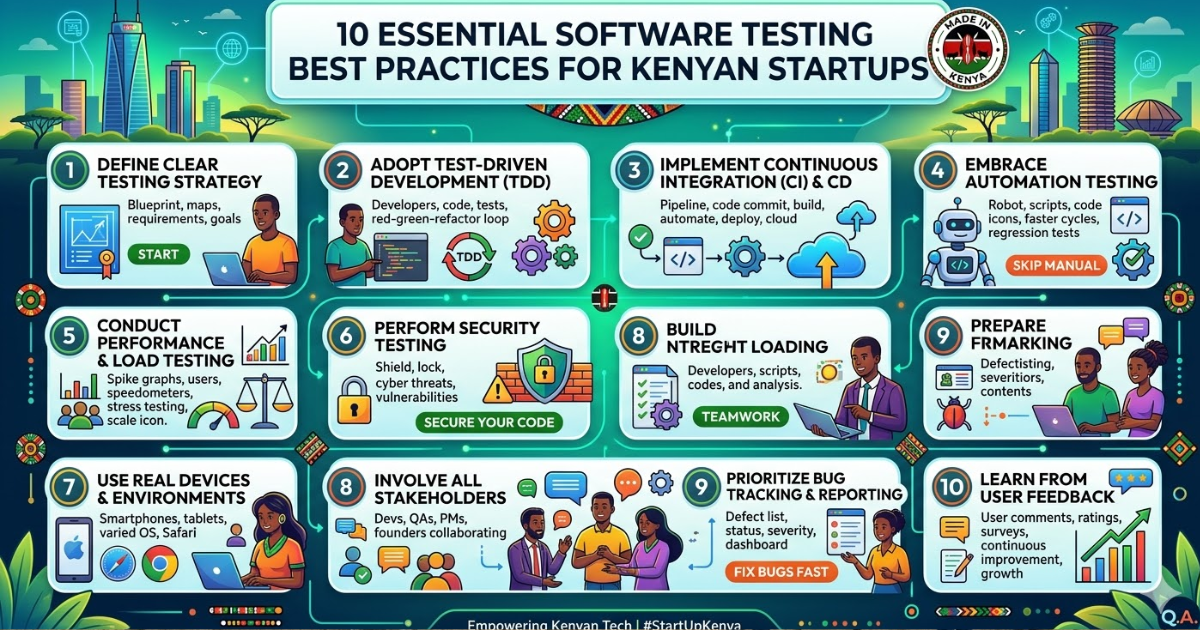
In today’s rapidly evolving digital landscape, delivering high-quality software is not just a competitive advantage; it’s essential for survival. For Kenyan startups, ensuring your applications are reliable, efficient, and bug-free can significantly impact user satisfaction, retention, and overall business growth. Implementing effective software testing best practices provides a structured approach to quality assurance, enabling teams to identify defects early, reduce costs, and accelerate delivery. This guide highlights 10 essential software testing best practices, offering actionable insights tailored for Kenyan startups.
1. Establish a Comprehensive Test Strategy
A well-defined test strategy is the backbone of effective software quality assurance. It outlines objectives, scope, testing types (unit, integration, system, acceptance), resource allocation, and risk management.
For startups, a focused yet thorough approach works best. Prioritize features with the highest business impact and clearly document testing objectives. This strategy ensures alignment across development and QA teams and provides a framework for efficient and consistent testing processes.
2. Implement Shift-Left Testing
Shift-left testing involves initiating testing activities early in the development cycle. Rather than leaving testing until the end, developers and QA teams collaborate from the outset.
Early testing allows defects to be identified and resolved before they escalate into costly issues. Unit testing and integration testing during development help maintain code quality and reduce post-release failures, ensuring that features meet business and user requirements from day one.
3. Leverage Test Automation
While manual testing is essential for exploratory and usability scenarios, automated testing is critical for scalability and efficiency. Automated tests speed up regression cycles, minimize human error, and ensure consistent outcomes.
Platforms like testRigor, as an AI software testing tool, simplify automation by enabling teams to create, maintain, and execute tests without extensive coding expertise. Features such as fast feedback loops, easy maintenance, and team collaboration make it particularly valuable for startups that need to balance speed with quality.
4. Maintain Detailed Test Documentation
Test documentation plays a crucial role in quality assurance. Comprehensive records of test plans, test cases, bug reports, and execution results improve accountability and transparency.
For Kenyan startups, proper documentation ensures knowledge retention, accelerates onboarding for new QA personnel, and facilitates communication between distributed teams. Cloud-based tools enhance accessibility and version control, keeping everyone on the same page.
5. Integrate Testing into CI/CD Pipelines
Continuous Integration (CI) and Continuous Deployment (CD) are essential for modern software development. By integrating automated tests into CI/CD workflows, every code change is validated before deployment.
This approach not only prevents defects from reaching production but also provides immediate feedback to developers. Combining CI/CD with test automation allows startups to release updates confidently and maintain a high standard of software reliability.
6. Conduct Cross-Platform and Device Testing
Kenyan users access applications across diverse devices and platforms. Testing on multiple browsers, operating systems, and devices ensures a consistent user experience.
While emulators can be used for early-stage testing, real-device testing is crucial for final validation. Cross-platform testing minimizes errors, reduces user frustration, and enhances product adoption.
7. Adopt Risk-Based Testing
Risk-based testing prioritizes efforts on areas with the highest likelihood of failure and the greatest business impact. Not all bugs are equally critical, and resources should be allocated accordingly.
For startups, this means focusing on features that are vital to revenue or core functionality. High-risk areas are tested thoroughly first, ensuring that critical issues are addressed promptly while optimizing limited testing resources.
8. Encourage Exploratory Testing
Exploratory testing allows QA teams to identify defects that structured testing may miss. It emphasizes learning, investigation, and adaptability, making it ideal for innovative or rapidly changing products.
By simulating real-user interactions, testers uncover usability issues, edge cases, and unexpected behaviors. This approach complements automated and structured testing, providing a holistic quality assurance strategy.
9. Promote Code Reviews and Peer Testing
Software quality is a shared responsibility. Peer code reviews and testing foster collaboration and knowledge sharing within development teams.
Code reviews detect logical errors, enforce coding standards, and enhance maintainability. Peer testing introduces fresh perspectives, often revealing issues overlooked by the original developer. For startups, a culture of shared accountability accelerates problem-solving and improves overall code quality.
10. Monitor Metrics and Continuously Improve
Testing is an ongoing process. Key performance indicators (KPIs) such as defect density, test coverage, and bug resolution time help assess the effectiveness of your testing strategy.
By analyzing metrics, teams can refine test approaches, optimize automation, and address gaps in quality processes. Continuous improvement ensures that software evolves alongside user needs and market expectations, positioning startups for long-term success.
Conclusion
For Kenyan startups, prioritizing software quality is a strategic investment. By adopting these 10 essential software testing best practices, startups can reduce errors, accelerate development, and enhance user satisfaction. Integrating platforms like testRigor as an AI software testing tool streamlines automation, supports continuous testing, and fosters collaboration, ensuring that teams can deliver high-quality software efficiently.
Ultimately, effective testing isn’t just about catching bugs; it’s about building trust, enhancing reliability, and creating a foundation for sustainable growth in a competitive digital market. By embedding these practices into your development workflow, Kenyan startups can confidently deliver software that meets both user expectations and business objectives.